Thursday, March 16, 2017

FAML 300 04 Week 11: Transitions in Marriage: Fidelity and Intimacy


Between husband

This week’s topic is a very sensitive one, and probably something most of us have a hard time speaking about. I know that I didn’t ask very many questions growing up or even when I was making plans to get married. The only preparation I remember making was having a doctor appointment making sure I was physically healthy. I also read “Between Husband and Wife: Gospel Perspective on Marital Intimacy” by Douglas E. Brinley and Stephen E. Lamb. I truly don’t think anything really sunk in, because I was too embarrassed and naïve to allow myself to learn that this was something important. 

Intimacy is not something to be embarrassed about
 President Hugh B. Brown said, “Thousands of young people come to the marriage altar almost illiterate insofar as this basic and fundamental function is concerned. The sex instinct is not something which we need to fear or be ashamed of. It is God-given and has a high and holy purpose. . . . We want our young people to know that sex is not an unmentionable human misfortune, and certainly it should not be regarded as a sordid but necessary part of marriage. There is no excuse for approaching this most intimate relationship in life without true knowledge of its meaning and its high purpose” (Hugh B. Brown, You and Your Marriage, Bookcraft, 1960, pp. 73, 76).

Intimacy is fun, comforting, romantic, and spiritual.
 I was one of those illiterate young adults, feeling too embarrassed to talk. Sean E. Brotherson wrote an article for Miridian Magazine, “Fulfilling the Sexual Stewardship in Marriage,” in which he told how he was preparing to get married and realized he only had a basic understanding of marital intimacy. He turned to his mother and asked “what that experience was really supposed to be like. My mother laughed and said that sometimes it was fun, sometimes it was comforting, sometimes it was romantic, sometimes it was spiritual, and sometimes it was just a willingness to love. I still think that's about the best answer I've ever heard on that question” (2003).
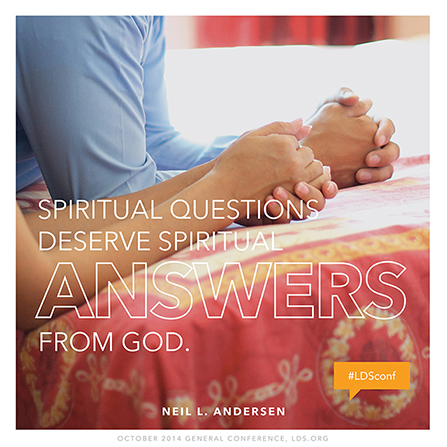
 An image of a man’s hands and a woman’s hands folded in prayer, combined with a quote by Elder Neil L. Andersen: “Spiritual questions deserve spiritual answers.”
It is okay to ask someone you trust answers to these questions. It is especially important for us to turn to our spouse after we are married and freely talk to each other about this aspect of marriage. Marital intimacy is a unifying aspect of marriage. Just as Sean Brotherson’s mother taught. Intimacy is fun, comforting, romantic, spiritual, and a way for full expression of love. It is way to bind a husband and wife’s hearts together as one. 

 Six pairs of feet are seen standing in a circle around a heart drawn in the sand, with the sun shining in the background.

This intimacy between husband and wife is good, and even though we need to be careful to only talk about it in respectful ways it is good. We don’t speak openly about sacred experiences, because that would diminish its special-ness, this too applies to intimacy. Elder Parley P. Pratt said, “Our natural affections are planted in us by the Spirit of God, for a wise purpose; and they are the very mainsprings of life and happiness—they are the cement of all virtuous and heavenly society. The fact is, God made man, male and female; he planted in their bosoms those affections which are calculated to promote their happiness and union.” (Parker Pratt Robison, ed., Writings of Parley Parker Pratt, Salt Lake City: Deseret News Press, 1952, pp. 52– 53.)

 A woman sitting outside with a man while hugging him from behind and kissing his cheek in an engagement picture.

My purpose in sharing these thoughts is to help married couples to feel more comfortable opening up with each other about their intimate relationship. Be able to talk about how each one feels. To have couples feel the way Sean Brotherson’s mother taught her son. If husband and wife are striving to love and fulfill the needs of the other, they will feel more love and unity toward one another.

Friday, March 10, 2017

FAML 300 Week 10: Seeking to Understand


We all have dreams
We have read and discussed a lot about ways to stay emotionally connected with your spouse as well as how to handle differences and conflict. Through this post I want to think about dreams. In the book I have been referencing a lot by John Gottman, “The Seven Principles for Making Marriage Work,” we learn about something he calls gridlock. Gottman teaches that all couples have differences that will never change, but “when partners can’t find a way to accommodate these perpetual disagreements” this is gridlock (chapter 11). These are the symptoms of Gottman’s gridlock:

  1.  You’ve had the same argument again and no resolution.
  2. The issue can’t be addressed with humor, empathy or affection.
  3. The issue is increasingly polarized.
  4. Compromise seems impossible, because it would mean giving up something important.

The issues stem from unfulfilled dreams

Gottman goes on to tell us that these kinds of issues in marriage usually stem from an unfulfilled dream. I think a lot of young and early marriages suffer from this kind of conflict because it is hard to always let your spouse know all that you expect or dream. Most of these issues are things that one or the other spouse feels gives purpose to life. Here are some of the dreams he listed:
  • A sense of freedom
  • Feeling at peace
  • Exploring who I am
  • Adventure
  • A spiritual journey
  • Justice
  • Honor
  • Consistency with my past values
  • Healing
  • Having a sense of power
  • Dealing with growing older
  • Exploring a creative side of myself
  • Getting over past hurts
  • Asking God for forgiveness
  • Exploring an old part of myself I have lost
  • Having a sense of order
  • Being productive 
  • Getting my priorities in order


I wanted to list quite a few so that you can get an idea of what these “dreams” are made of. I remember as a newly wed having these dreams become manifest as I had in my head the way things were suppose to be especially when it comes to spirituality. Thankfully my husband is an amazing communicator and we have been able to be very open about our thoughts and expectations. When children came along, we already had spoken about how we would teach them spiritually. We started from the beginning having a family night each week with a spiritual lesson, we would read scriptures each night, pray together over meals and in our comings and goings, we set a tradition of going to church every week and sitting together as a family. Our dreams have blended together as one. 

When children came along, we had already talked about family routines and traditions.
I guess this doesn’t show a kind of dream that is in conflict. So I will give you an imaginary example that I had those dreams and expectations I mentioned in the last paragraph, but in this imaginary example my husband was agnostic and wanted nothing to do with religion. This would be a point where I would feel stuck, not wanting to lose the dream I have by not doing those things that are important to me. Yet my husband might feel threatened by the control organized religion has had in his life. He might want to have our children grow up free to believe what they want and not be indoctrinated into a religion. This kind of issue would cause a grid lock.

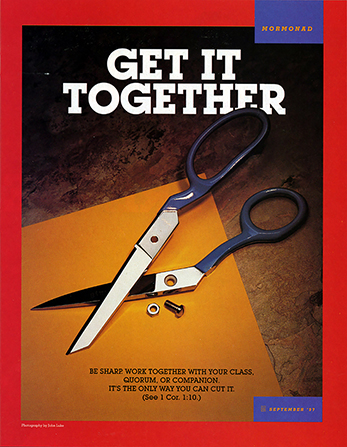
An image of a pair of broken scissors on a table, paired with the words “Get It Together.”

Gottman shares that in these times we need to take turns listening to “the dream” in a non-judgmental way. If we can hear our spouse speak from their heart what their dream is we are on our way to finding a way to compromise. Gottmans says that when we are listening to our spouse’s dream that might be in opposition to our own, we need work on soothing ourselves and if it gets to be too much tell your spouse you need a break to calm down before continuing. When compromising you find areas you can negotiate and be flexible with, and also the areas that you cannot give up without “violating your basic needs or core values.”

If we can work through these dreams and expectations then we can work through conflict without it turning into an issue that will threaten your marriage.

Friday, March 3, 2017

FAML 300 Week 9: Managing Conflict; Consecrating Ourselves


In “The Seven Principles for Making Marriage Work,” John M. Gottman states in chapter 8 that there are two kinds of problems in marriage, perpetual and solvable. Of those two kinds of problems, Gottman has found that 69% are perpetual problems.  Perpetual means that these particular problems “will be a part of your lives forever in some form or another.” How is this helpful? Does this mean we are doomed for failure if we find we have perpetuating problems? No, as I understand what Gottman is saying, as we come to recognize a reoccurring problem in our marriage, we can use coping tools and learn to handle these reoccurring problems in a way that won’t destroy our marriage.

Two kinds of problems: Solvable and Perpetual
 I am a very slow and careful person. I am sure my husband could see that a little bit before we got married, but the full weight of my slow, careful decision making probably hit later after marriage life was in full swing. This is under the perpetual problems that won’t just go away after a certain event or decision. This is something that will reoccur every time we have to make important and even non-important decision throughout the day. I am sure it sometimes irks my husband that I just can’t go a little faster.  We can work through this as he practices patience, and perhaps plans for the extra amount of time; and I practice being more aware of time constraints. This is something we will continually work on, but because we have built a strong foundation of love, acceptance, and friendship, I know it is not going to destroy our marriage. As I stated in another post, humor always helps to ease tension that may arise out of these kind of irritations.

We can get along because we have a foundation of love, acceptance, and friendship.

 This leads me to what H. Wallace Goddard said in “Drawing Heaven into your Marriage,” in chapter six on Consecration. He shares that “the more [we] turn [our] lives over to God, the better [our] lives become.” As we turn our lives over to God, or consecrate our lives and our marriage, we will be more willing to bear the problems and weaknesses that happen in marriage. In marriage, God “invite[s us] to dedicate our lives, our talents, our weekends, and our weaknesses to the sacred enterprise of sanctifying our marriage” (page 98).

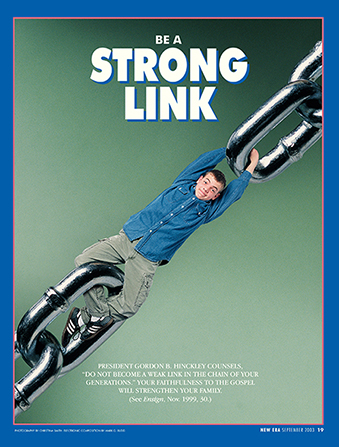
A conceptual photograph showing a young man acting as a link in a metal chain, paired with the words “Be a Strong Link.”


I would say that the weaknesses we all have are what generally cause the perpetual problems in marriage, because those are the traits and aspects of life that we struggle with the most. But if we turn ourselves over to God, we will blessed with patience and forgiveness. We will love each other in spite of those weaknesses.
President James E. Faust said, “We need to recognize and acknowledge angry feelings. It will take humility to do this, but if we will get on our knees and ask Heavenly Father for a feeling of forgiveness, He will help us. The Lord requires us “to forgive all men” for our own good because “hatred retards spiritual growth.” Only as we rid ourselves of hatred and bitterness can the Lord put comfort into our heart” (April 2007, The Healing Power of Forgiveness).
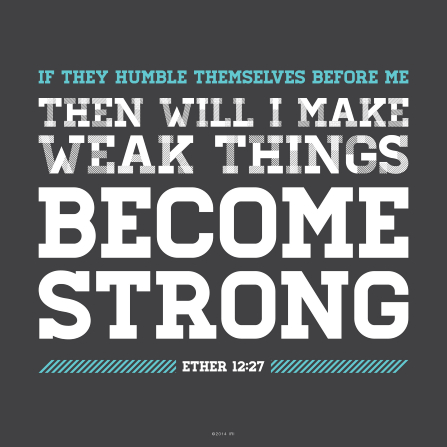
If we take that quote and apply it to any weakness we have, “We need to recognize and acknowledge weaknesses. … Get on our knees and ask Heavenly Father for … forgiveness, [and] help.” We can make our perpetual problems an area of strength through Heavenly Father’s help, because he can “make weak things [or marriages] become strong” (Ether 12:27).


A plain gray background with the words from Ether 12:27 printed over the top.

Here are some keys John Gottman came up with to help managing when conflict does arise in your marriage:
  1. Negative emotions are important. Gottmans says it is important to listen to your spouse, even if it hurts to listen to the anger or sadness. He says, "Negative emotions hold important information about how to love each other better.
  2. No one is right. We need to realize that we all have our opinions about things and neither one of us is absolutely right. One spouse may like to squeeze the tooth paste in a systematic way, while the other spouse may just squeeze  in the middle. Neither is wrong and they both get tooth paste. Our spouse doesn't need us to criticize them on how they do things just because we feel our way is better.
  3. Acceptance is crucial. Gottman says, "It is virtually impossible for people to heed advice unless they believe the other person understands, respects, and accepts them for who they are." All of us flourish and become better when we know we are accepted for who we are. We feel more ready to change and take advice when we know we are respected and accepted.
  4. Focus on Fondness and admiration. Gottman gives the exmple of a older couples that have remained happily married for a long time and have "learned to view their partner's shortcomings and oddities as amusing parts of the whole package."
"For a marriage to go forward happily," Gottman adds,"you need to pardon each other and give up on past resentments. ... When you forgive your spouse, you both benefit. Bitterness is a heavy burden. As Shakespeare wrote in The Merchant of Venice, mercy is 'twice blessed. It blesses him that gives and him that takes.'"

Marriage can be so much more to us if we will let go the petty picking, and instead be forgiving. In our spouse we can have our most dear and trusted friend.